Introduction: The Magic of Extrusion
The Core of the Line - The Rotary Head Extruder
The single most critical component in the Kurkure Frymus Line is the Extruder. Unlike a standard pellet extruder, the Kurkure machine uses a highly specialized continuous process designed to achieve the product’s signature texture and shape.
| Extruder Feature | Function | Impact on Product |
|---|---|---|
| Raw Material | Pre-mixed corn grits or corn meal. | Low-cost base with excellent expansion characteristics. |
| Barrel & Screw | Heats, kneads, and compresses the raw material under controlled pressure. | “Cooks” the material through a combination of heat and friction. |
| Rotary Die Head | Forces the cooked dough through precision-shaped openings. | Creates the curved and twisted shape characteristic of Kurkure snacks. |
| High Shear Rate | Rapidly cuts the extruded dough at the die exit. | Causes the dough to puff instantly due to the sudden pressure drop, forming the desired crunchy texture. |
Precision is Paramount: The rotational speed of the cutting head and the internal temperature and pressure within the barrel must be precisely controlled—often through a PLC-based system—to maintain a consistent expansion ratio and uniform product length for every curl.
Key Stages of the Full Kurkure Frymus Production Line
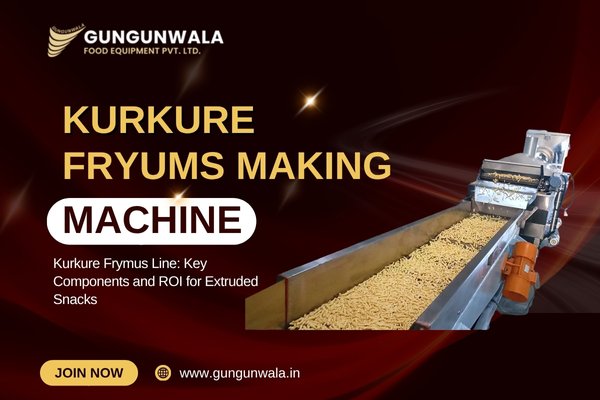
A high-capacity, fully automatic Kurkure Frymus Production Line is composed of five main equipment groupings that work seamlessly to ensure consistent quality, high output, and long-term reliability.
- Grit Mixer & Feeder: Uniformly blends raw materials such as corn meal, rice meal, and water before feeding the mix into the extruder for precise consistency and texture control.
- Extrusion & Cutting: The Rotary Head Extruder forms the signature curls and deposits the raw, un-fried product onto the conveyor system for further processing.
- Drying / Frying System:
- Continuous Fryer (Most Common): Produces the classic crispy texture and golden color. It must maintain a high Oil Turnover Ratio (OTR) to ensure oil freshness and consistent product quality.
- Hot Air Roaster / Oven (Healthier Option): Roasts the snacks without oil, offering a low-fat alternative ideal for health-conscious consumers.
- De-Oiling / Cooling Conveyor: A vibrating conveyor or belt system gently removes excess oil (in fried versions) and cools the product to ambient temperature, preparing it for flavoring and packaging.
- Flavor Application System:
- Linear Feeder: Ensures a uniform and continuous flow of snacks into the seasoning drum.
- Slurry Mixing System: Blends edible oil and dry seasoning (masala) into a smooth, evenly distributed slurry.
- Rotary Flavoring Drum: Rotates and tumbles the snacks while the slurry is sprayed inside, guaranteeing a uniform, 360-degree coating for maximum flavor consistency.
The High ROI of Extruded Snacks
The Kurkure/Frymus line is one of the most profitable snack segments due to its low raw material cost and high value-add:
- Low Input Cost: The primary raw material (corn grits/rice meal) is significantly cheaper than potatoes.
- High Expansion Ratio: The extrusion process causes the product to puff up (expand), meaning a small amount of raw material produces a large volume of finished product. This directly translates to higher profit margins per finished kilo.
- Minimal Waste: Unlike potato chips (which have peel waste), the waste in an extruded line is primarily fines (small particles) separated by a rotary sieve, which can be minimized with high-quality machinery.
- Versatility: The same line can be used to produce various shapes and base products simply by changing the die head and seasoning, allowing for quick response to market trends.
Quick Financial Summary (Estimate for a 200 KG/Hr line ):
Upfront Investment (Plant & Machinery): Ranges from ₹10\L to ₹40\L (approx. depending on automation level and capacity).
Production Cost per KG (Raw Material + Oil + Energy): Significantly lower than fried snacks like chips.
Net Profit Margin: Often exceeds 25-30% when operating at high capacity.
The efficiency and high margin of the extrusion process ensure a typically fast Return on Investment (ROI), often achieved within the first 12-24 months of optimized operation.
Ready to capitalize on the booming extruded snack market?
Our engineering team specializes in high-efficiency, stainless steel Kurkure/Frymus Extrusion Lines. Contact us today for a detailed plant layout and ROI calculation tailored to your target production capacity!