Introduction: The Hidden 10 % Cost
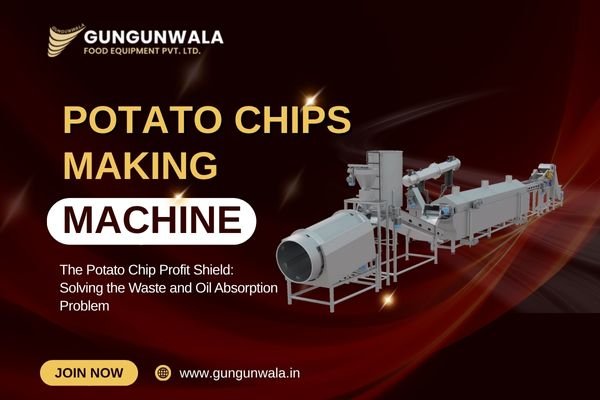
In potato chip production, the final profit margin isn’t just determined by sales price; it’s potected by minimizing two major hidden costs: raw material waste and cooking oil absorption. Combined, these can drain 5% to 10% of your potential profit annually.
A world-class, fully automatic chips making line is not just fast; it is efficient. As a leading Manufacturer based in Ahmedabad, we engineer every stage of the process – from washing to frying—to act as a profit shield.
Minimizing Raw Material Waste (The Slicer & Washer)
1. Precision Slicing Technology
- The Problem: Conventional or low-quality slicers often tear the potato instead of cutting it cleanly. This creates rough edges and high levels of non-uniform fines that either burn in the fryer or clog the washing system — increasing waste disposal costs.
- The Solution: Our Rotary Multi-Blade Slicer Machine features precision – engineered stainless steel blades that deliver an ultra-clean, uniform cut. Operating at controlled high speed, it minimizes fine generation to < 1% and prevents starch loss — producing chips with better texture and consistent thickness.
- The Benefit: Maximum Yield and Profitability. A cleaner cut means more usable chips per kilogram of raw potato, directly improving your production efficiency and return on investment (ROI).
2. Efficient Washing and Destoning
- The Problem: Poor washing leaves behind surface starch and impurities, which mix into the frying oil and accelerate its breakdown — increasing Total Polar Compounds (T.P.C.) and reducing oil life.
- The Solution: Our advanced Rotary Washer and Destoner completely removes starch, mud, and small debris before the chips enter the Continuous Fryer. Its integrated water recirculation system also reduces water consumption, ensuring both sustainability and lower operating costs.
Conquering High Oil Absorption (The Fryer System)
In any Potato Chips Manufacturing Line, edible oil represents the largest variable cost after the raw potatoes themselves. Excessive oil absorption is a clear indicator of poor fryer design or inadequate temperature control — resulting in greasy chips, faster oil degradation, and higher operating costs.
1. Temperature Stability and Oil Turnover Ratio (OTR)
- The Problem: Chips absorb oil primarily at two critical points — when exiting the fryer and when the oil temperature drops. Inefficient systems fail to maintain uniform heat, causing temperature fluctuations that increase absorption and affect product consistency.
- The Solution: Our integrated Continuous Fryer and
Thermic Fluid Heat Exchanger maintain precise temperature stability within ±1°C. The fryer’s Low Oil Holding Capacity design ensures a fast Oil Turnover Ratio (OTR), meaning the oil is continuously refreshed. This minimizes oxidation, enhances product shelf life, and produces crisp, low-oil chips.
2. Oil Removal and Filtration
- The Problem: After frying, excess surface oil adheres to the chips, increasing the final oil percentage.
Additionally, suspended fines (tiny food particles) accelerate oil degradation, raising Total Polar Compounds (T.P.C.) levels — forcing early oil disposal and higher replacement costs. - The Solution: Each line is equipped with a high-frequency Vibratory De-Oiling Conveyor
that instantly removes surface oil as the chips exit the fryer.
A closed-loop Micro-Filtration Unit continuously removes fines from the oil, maintaining low T.P.C. levels and extending usable oil life by up to 30%. - The Benefit: Reduced Oil Consumption — typically just 28–32% final oil content — resulting in substantial monthly savings and a cleaner, lighter, more marketable chip.
With optimized temperature control, effective de-oiling, and advanced filtration, our Continuous Frying Systems deliver both product excellence and long-term cost efficiency — safeguarding your ROI from day one.
Protecting Profit in Packaging (Reducing Giveaway)
The final, often overlooked source of waste in any Snack Production Line occurs during packaging — in the form of product giveaway.
- The Problem:
Traditional volumetric fillers or outdated weighing systems tend to overfill each packet to ensure the declared weight.
Even a small excess of 1–2 grams per pack, when multiplied across millions of packets, translates to significant annual profit loss. - The Solution:
The advanced Multi-Head Weigh Filler System uses a precision PLC control and 10–14 radial heads to determine the exact combination of weighments closest to the target weight (e.g., 99.9 g for a 100 g packet). This ensures both accuracy and speed in high-output snack packaging. - The Benefit:
Product giveaway is minimized to < 0.5%, safeguarding your ROI on every sealed bag while maintaining customer satisfaction through consistent, compliant weights.
By upgrading to an automated Multi-Head Weigh Filler, snack manufacturers eliminate invisible losses, improve line efficiency, and directly convert precision into profit.